
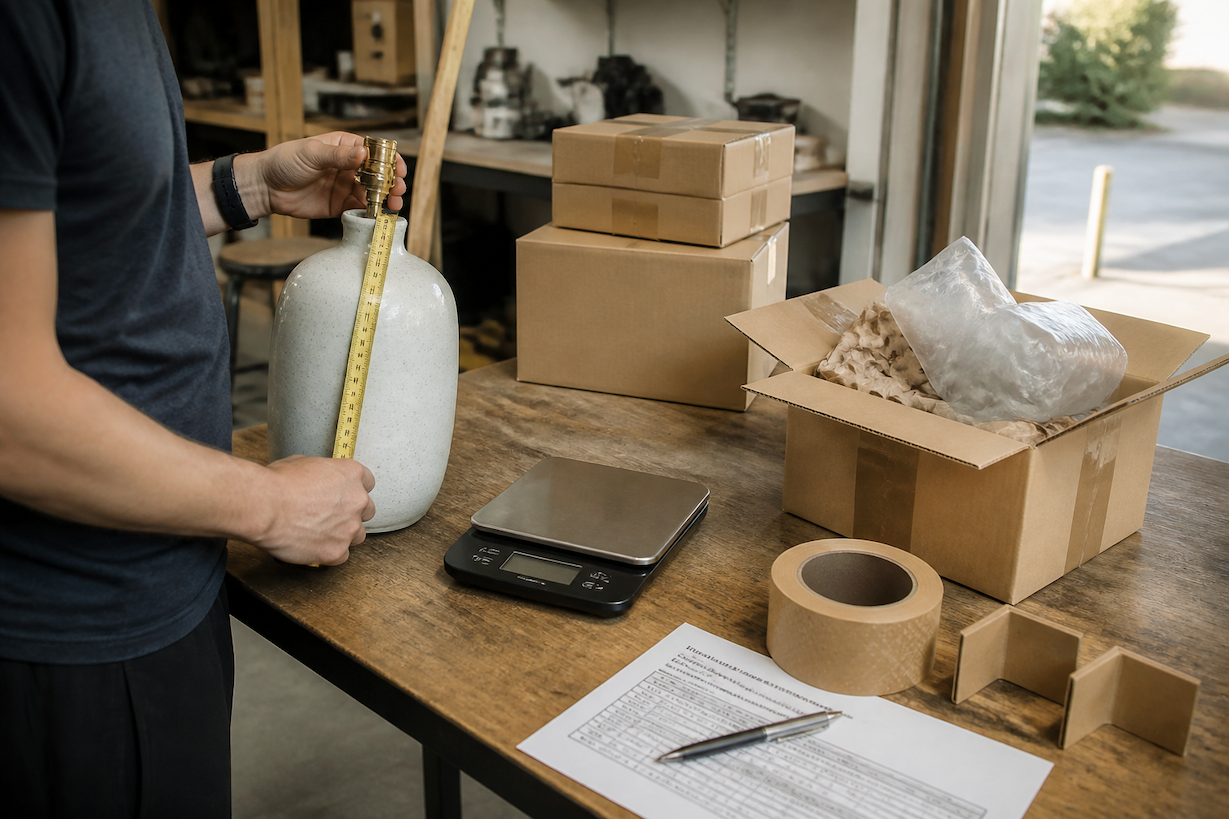
What You’ll Need Before You Start
Gather this stuff first — it’ll save you a second trip to the tape aisle.
- A kitchen or shipping scale — guessing weight is how boxes fail halfway across an ocean.
- A tape measure for length, width, and height (round up to the nearest inch, always).
- Corrugated boxes rated for the job — standard 32 ECT for lighter items, double-wall or triple-wall for anything heavy or dense.
- Reinforced or water-activated tape — clear packing tape alone doesn’t hold up over long-haul routes.
- Void fill — packing paper, air pillows, or foam to stop shifting during rough handling.
- Corner protectors if you’re shipping anything fragile or top-heavy.
- A marker for labeling “fragile” or “this side up” where needed.
- Basic knowledge of ECT/Mullen ratings — you don’t need an engineering degree, just enough to read a box spec sheet.
- Destination details — knowing whether it’s traveling by air or ocean freight changes how much reinforcement you need.
Time needed: about 15-20 minutes per shipment once you’ve got your supplies sorted. Longer the first time, faster every time after.
Here’s a number that stops most sellers cold: a box that survives 400 miles of UPS ground transit can still fail catastrophically after 40 days on a cargo ship. Different stress, different physics, same box — and that’s the mistake. When you ship boxes internationally, you’re not dealing with one truck ride and a porch drop. You’re dealing with stacking pressure in a container, humidity swings crossing the equator, and three or four times the handling touches of a standard domestic package.
Most small sellers pick box strength the same way they pick a shirt size — close enough, done. A 32 ECT box that’s perfectly fine for a customer three states away can crush under a pallet load in a shipping container somewhere off the coast of nowhere. And once that box fails, you’re not just out a product. You’re out the shipping cost both ways, a furious customer, and a review that follows you around for months.
So let’s get specific. This is about picking the right ECT or Mullen rating, sizing the box to the product instead of whatever’s on the shelf, and reinforcing it so it survives a trip that’s nothing like a typical domestic run.
What You’ll Achieve and What You Need Before You Start
Picture this: a seller in Ohio packs a ceramic lamp base in a single-wall box, tapes it up — and hands it to a freight forwarder headed overseas. Three weeks later, it arrives crushed — because the box survived a local UPS truck ride but never stood a chance against pallet stacking and multiple freight transfers. That’s the gap most people miss when they ship boxes internationally. Domestic strength standards and international freight standards aren’t the same thing.
The Goal: Boxes That Survive Freight Handling, Not Just Ground Shipping
Your goal here isn’t just picking a box — it’s matching box strength to how many times that box gets handled, stacked, and re-stacked before it reaches its destination. Ocean and air freight involve more touchpoints than a single domestic hop.
Tools and Info to Gather First (Weight, Dimensions, Destination)
Before choosing anything, grab three numbers: actual item weight, outer box dimensions, and final destination country. This piece on what cardboard boxes data reveals about right-sizing in high-volume shipping is worth a quick read before you order anything.
Step 1: Understand ECT and Mullen Ratings Before You Pick a Box
Grab the wrong box strength and your international shipment comes back crushed — full stop. Before you even think about tape or labels, look at the numbers stamped on the box itself. Most corrugated cardboard boxes carry either an ECT rating or a Mullen burst rating, and mixing them up is one of the fastest ways to under-protect a pallet headed overseas.
What ECT Actually Measures on the Box Itself
ECT stands for Edge Crush Test. It measures how much stacking weight the box’s edge can take before it folds. A 32 ECT box handles roughly 65 lbs — fine for domestic runs, but risky when your box sits at the bottom of a stacked container for three weeks at sea.
Mullen Test vs ECT — Which Number Actually Matters for International Freight
Mullen (burst strength) tests how much pressure punctures the face of the board — useful for rough handling, less useful for stacking. For international freight, ECT wins because ocean containers stack boxes for days. Check what are standard shipping box sizes and their uses before you order.
Step 2: Match Box Strength to Your Product’s Weight and Density
How heavy is what you’re actually sending, and how dense is it? That’s the question that decides everything before you tape a single flap. Weight tells you part of the story, but density — how much mass is packed into a small space — matters just as much. A box of 10 lb ceramic mugs needs way more support than a box of 10 lb pillows. International routes add rough handling, longer transit, and multiple hand-offs, so guessing wrong here gets expensive fast. Grab your scale, weigh the product plus fill, then pick strength based on that number — not on whatever packaging boxes happen to be sitting in your garage. You can browse sturdy, correctly-rated packaging boxes built for exactly this kind of sorting.
Standard 32 ECT Boxes: When They’re Fine and When They’re Not
Standard single-wall boxes rated 32 ECT (roughly 200# test) handle items up to about 65 lbs. Fine for clothing, books, and general merchandise. Not fine for anything dense or fragile crossing borders.
Double-Wall and Triple-Wall: When Heavy or Dense Items Need More
Double-wall runs up to 80 lbs; triple-wall covers 100+.
Dense metal parts, bulk glassware, or long international hauls? Go heavier — every time.
Step 3: Account for International Transit Stress That Domestic Ship Boxes Don’t Face
Here’s a number that surprises most sellers: international freight moves through 3-5 separate handling points before it reaches the customer, compared to roughly 2 for a domestic parcel. Every one of those handoffs adds risk. A box that survives a truck ride to a regional hub might get crushed under a pallet of heavier goods on a cargo ship three weeks later.
Extra Handling, Longer Transit, and Stacking in Cargo Containers
Ocean freight containers get loaded tight — boxes get stacked six, seven, sometimes eight units high with no room to shift. That means your standard 32 ECT box, fine for a quick domestic hop, might buckle under sustained weight over a 30-day voyage. Bump up to double-wall construction for anything going overseas, and seal every seam twice. Don’t skimp here. Quality packing tape for shipping matters more on long routes because adhesive failure mid-transit means a box that arrives open, not just dented.
Humidity and Temperature Swings During Ocean and Air Transit
Cargo holds swing from freezing cargo bays to sweltering tarmac heat in the same trip. That moisture cycle weakens plain cardboard fast. Water-resistant coatings or poly-lined liners aren’t optional for international shipments — they’re the difference between arrival and a soggy mess.
Step 4: Choose the Right Dimensions to Avoid Oversized or Underprotected Boxes
Bigger isn’t safer. That’s the myth most sellers believe right before they overpay on an international shipment. A box that’s too roomy lets contents shift, and shifting is exactly what cracks corners and crushes edges mid-transit — not to mention what it does to your rate.
Cube, Tall, Flat, and Long Boxes — Picking the Shape That Fits
Match the shape to the product, not the other way around. Cube boxes suit stacked or symmetrical goods. Tall boxes work for bottles, vases, or anything vertical. Flat boxes and mailing boxes fit apparel, documents, and lightweight items well. Long boxes handle rods, frames, or anything awkward-length. Guessing the shape wastes fill material and adds bulk that carriers charge for.
Why Oversized Boxes Cost More and Protect Less
International carriers price largely on dimensional weight, not just scale weight. A box with 3 extra inches on each side can bump you into a higher rate bracket even if the product inside weighs the same. Worse, empty space means more shifting, more damage claims, and more returns. Right-sizing isn’t a nice-to-have — it’s the single fastest way to cut shipping costs while actually improving protection.
Step 5: Reinforce Seams, Corners, and Closures for the Full Journey
Picture this: a box leaves a warehouse dock, gets tossed onto a truck, sits in a cargo hold for two weeks, then bounces through a foreign customs facility before reaching the buyer’s door. That’s the real trip your package takes when you ship boxes internationally — and standard tape just isn’t built for it.
Tape Choice: Why Water-Activated or Reinforced Tape Beats Standard Clear Tape
Clear packing tape looks fine on day one, but heat, humidity, and rough handling peel it loose fast. Water-activated tape bonds to the cardboard fibers themselves, so it won’t lift even after weeks in transit. Fiberglass-reinforced tape adds extra strength across seams that take the most stress — the center seam and the corners where forklifts and conveyor belts do the most damage.
Adding Corner Protection and Void Fill for Long-Haul Routes
Don’t skip corner protectors on heavier shipments. They stop crushing when boxes get stacked five or six high in a container. For lighter items shipping in a poly mailer, add extra void fill so nothing shifts. Loose contents inside any box — mailer or corrugated — cause more damage than the trip itself.
Common Mistakes to Avoid When Choosing Box Strength for International Shipping
Most damaged overseas shipments trace back to two dumb, avoidable errors. Fix these, and you’ll cut damage claims dramatically.
Mistake: Reusing a Domestic Box for an Overseas Shipment
That box that survived three ground shipments across the country? It probably won’t survive a cargo hold, a rough transfer between carriers, and a customs inspection where someone stacks a 40-lb crate on top. International routes mean more handling points, longer transit times, and rougher conditions than a UPS truck. Boxes get compressed, dropped, and left in humid warehouses for days. If you’re unsure what strength rating you actually need, check our breakdown of standard shipping box sizes before you tape anything shut.
Mistake: Guessing Weight Instead of Actually Weighing the Package
Eyeballing weight is how sellers end up with a bottom blowout mid-transit. Put the box on a scale — every time, no exceptions. A 28 ECT box rated for 65 lbs will fail fast at 80 lbs, and international carriers won’t be gentle with an overloaded box. Weigh first, then match the box.
Step 6: Verify Your Box Choice Before You Seal and Ship
Ready to tape it shut? Not so fast. Before any international shipment leaves your hands, run through a final check — it takes two minutes and saves you a customs delay or a crushed box on the other side of the ocean. Grab the item, the box, and your notes on weight and ECT rating, then confirm everything lines up before you commit tape to cardboard.
Quick Checklist: Weight, Rating, Fit, and Seal
Check these four things every time: actual item weight versus box max load, edge crush rating against total shipment weight, snug fit (no more than an inch of wiggle room), and a fully sealed bottom with H-taping. If you’re still unsure which dimensions fit your product, review a breakdown of common shipping box sizes before finalizing your pick. Skipping this step is how boxes arrive with blown-out corners.
When to Size Up One Strength Level Just to Be Safe
International routes mean more handling, longer transit — rougher conveyor belts. So here’s the rule: if your item sits right at the edge of a strength rating, bump up one level. It costs a little more per box but costs far less than a damage claim and a furious customer overseas.
How-To FAQ
What ECT rating should I use for international shipping boxes?
Go with 32 ECT for anything under 40 lbs and double-wall (44 ECT) for anything heavier or going overseas. International routes mean more handling, more stacking, and longer transit times, so that extra wall thickness earns its keep. If your box gets tossed on a pallet with six others for three weeks on a boat, standard single-wall just doesn’t hold up the same way.
Can I reuse a domestic shipping box for an international shipment?
Technically yes, but you shouldn’t if the box has already been through one shipping cycle. Corrugated fibers weaken every time a box gets compressed, taped, and re-taped. A box that survived a 3-day ground trip might fold under the pressure of a 3-week ocean freight route. If you’re reusing boxes to save money — and a lot of small sellers do — save that habit for domestic orders only.
How do I know if my box is too weak for what I’m shipping?
Press down on the top and sides — if it flexes more than a little, size up. A quick gut check: stack two similar boxes and sit a third on top for a minute. If the bottom box bows out, that’s your answer. Weight alone doesn’t tell the story; dense items (books, metal parts, ceramics) stress corrugated walls more than bulky lightweight ones.
Does box strength affect my shipping rate?
Yes — heavier-duty boxes weigh more, and that added weight can bump your rate, but it’s usually cents on the dollar compared to a damage claim. Carriers price on dimensional weight and actual weight combined, so double-wall won’t wreck your margins. What wrecks margins is a refund plus a bad review because a standard box collapsed halfway across an ocean.
What’s the safest tape for international boxes?
Water-activated (gummed paper) tape or reinforced fiberglass tape holds up far better than plain clear tape over long transit times. Standard tape can lose adhesion in humidity or heat, and that’s exactly what long international routes throw at it. Tape all seams in an H-pattern, not just the top — customs agents often open boxes for inspection, and you want a real seal on both ends.
Is it ever okay to size up a box strength level just to be safe?
Yes, — honestly, it’s a smart move whenever you’re unsure. The cost difference between standard and double-wall is small next to what you’d lose replacing a damaged item and refunding an unhappy customer overseas. When in doubt, go one level up — you won’t regret the extra protection.
Picking the right box for an overseas shipment isn’t a guessing game — it’s a checklist. Weigh the product, check the ECT rating against that weight, and pick a shape that fits without wasted space. Standard 32 ECT works fine for a lot of domestic orders, but freight containers, multiple handoffs, and weeks of humidity swings ask more of a box than a quick ground trip ever will. That’s why double-wall or even triple-wall construction earns its keep on longer routes, and why reinforced tape and corner protection aren’t optional extras. Sellers who ship boxes internationally without accounting for these stresses tend to find out the hard way, usually after a customer opens a crushed package on the other side of the world. So before you tape anything shut, run through the checklist one more time: weight confirmed, rating matched, fit checked, seams reinforced. If there’s any doubt about whether your box can handle the trip, size up one strength level. It costs a little more upfront and saves a lot more in refunds and damaged goods later.



Recent Comments