
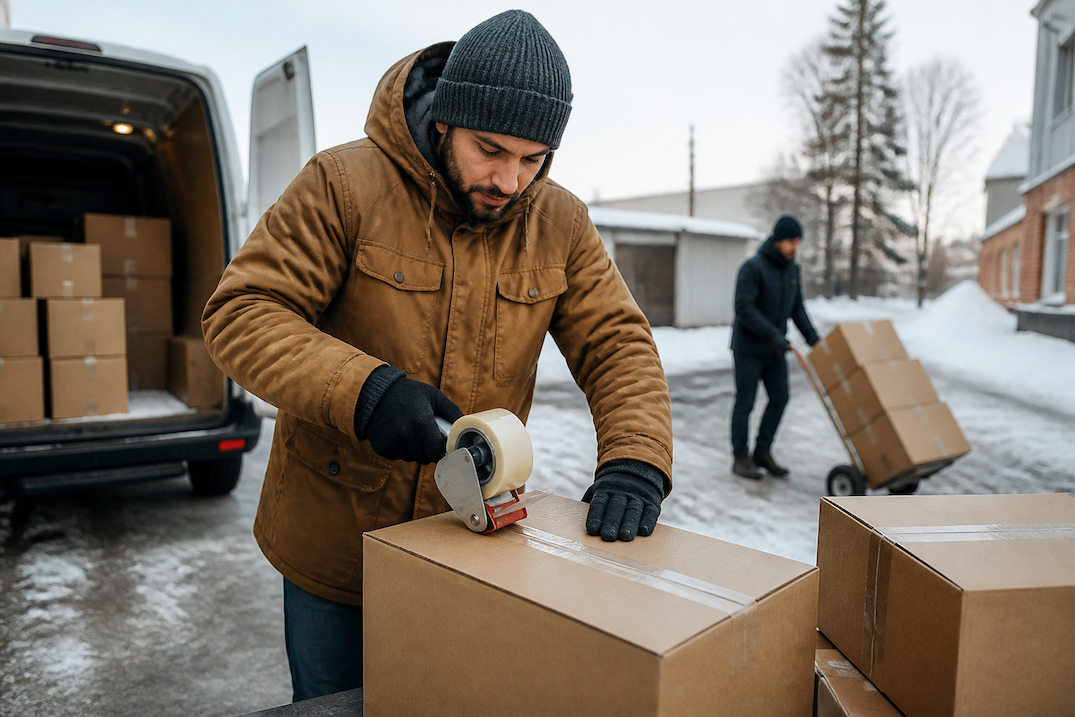
What You’ll Need
Cold shipping docks and unheated warehouses eat weak adhesive alive. Here’s what to gather before you tape a single box.
- Heavy duty packaging tape — a hot melt or acrylic formula rated for low temps, 1.88″ to 3″ wide depending on box size
- A tape gun or dispenser — hand pressure alone won’t seat cold adhesive properly
- Water-activated tape (optional but recommended for heavier or high-value boxes)
- Corrugated boxes rated for the item’s weight — don’t tape your way around an undersized box
- A heat source or warm staging area — even 10-15 minutes indoors before sealing helps adhesive grip
- A box cutter or scissors for clean tape cuts
- A dry cloth to wipe condensation or frost off box flaps before sealing
Skills needed: basic box assembly and taping technique — no special training required.
Time required: 5-10 minutes per box once you’ve got your tape and dispenser set up; add a few minutes if you’re warming boxes first.
Forty degrees and dropping — and that box you sealed an hour ago just popped open on the loading dock. Sound familiar? Cold weather turns ordinary box packing tape into a liability fast. Adhesive that grips like iron in a warm warehouse can go stiff and brittle once temps drop below 50°F, and the flaps you thought were locked down peel right back up mid-transit.
Here’s what most sellers miss: not all tape is built the same, and the tape that worked fine last July isn’t going to cut it for winter shipments. Cardboard itself gets harder and more brittle in the cold too, which changes how adhesive bonds to it. Get the wrong combination, and you’re looking at popped seams, exposed products, and customers opening damaged boxes instead of the item they paid for. The good news? Picking tape that actually holds in cold conditions isn’t complicated once you know what to look for — and that’s exactly where this gets practical.
What You’ll Achieve and What You Need Before You Start
Picture a warehouse loading dock at 6 am in January — 34°F, breath fogging, and a stack of cartons waiting to ship before the truck arrives. The crew grabs a roll of tape, seals a box, and the flap pops open an hour later. Cold air kills weak adhesive fast. By the end of this section, you’ll know exactly what to stock so that doesn’t happen to your shipments.
Materials: Tape, Dispenser, and Box Types to Have on Hand
Start with the right roll. A good box packing tape built for cold conditions won’t crack or lose grip once temps drop. You’ll also want:
- A hand-held tape gun (a dispenser saves seconds per box and applies even pressure)
- Standard corrugated cardboard boxes with clean, dry flaps
- Extra rolls on hand — cold snaps burn through tape faster than you’d think
- Heavy-duty options for anything over 40 lbs
Step 1: Understand Why Cold Weather Breaks Down Standard Packing Tape
Cold kills adhesive. That’s the short version. Most box packing tape uses an acrylic or hot-melt adhesive built to grab at room temperature — drop the box into a 20°F truck or an unheated warehouse dock, and that same adhesive stiffens up, loses tack, and stops bonding to cardboard the way it should. You’ll see corners peel, seams pop open in transit, and edges curl within hours of sealing. It’s not a fluke — it’s chemistry. Warehouses shipping through winter need shipping packing tape rated for temperature swings, not just the stuff that tested fine on a warm loading dock in July.
Cold-Weather Adhesive Failure vs. Room-Temperature Adhesive Failure
Room-temperature failure usually shows up slowly — tape yellowing, adhesive drying out over months. Cold failure happens fast, sometimes within a day. The tape looks sealed when applied, then releases as temps drop overnight. That’s the trap.
Step 2: Compare Heavy Duty Packaging Tape Options Rated for Low Temps
So which adhesive actually holds up when the thermometer drops? Not all tape chemistry behaves the same in a cold warehouse or an unheated delivery truck — and picking wrong means split seams on arrival.
Hot Melt vs. Acrylic vs. Water-Activated Tape for Cold Shipping
Hot melt tape grabs fast and cheap — it stiffens below freezing and can pop off corrugated edges. Acrylic tape costs a bit more, yet it keeps a flexible bond down into the 20s (Fahrenheit) — that’s why most cold-climate shippers lean on it. Water-activated (gummed) tape bonds to the cardboard fibers themselves once it dries, giving you a seal that won’t peel even in freezing loading docks (it just needs time to cure before the box gets tossed around).
For everyday cartons, good packing tape for shipping in an acrylic formula strikes the right balance between cost and cold-weather grip. Skip bargain-bin hot melt rolls once temps consistently dip below 40°F.
Step 3: Match Tape Thickness and Width to Your Box Weight and Size
Here’s a number that surprises most sellers: a box under 20 lbs needs roughly half the adhesive strength of one pushing 50 lbs — yet a lot of shippers grab the same roll for both. That’s a mistake in cold weather, when adhesive already loses grip. For light boxes (under 20 lbs), a 1.6 mil tape at 2″ width does the job. For anything in the 20-50 lb range, move up to 2.6-3.0 mil. Boxes over 50 lbs need reinforced or filament tape across every seam, not just the top — bottom flaps.
Width matters too — 3″ tape covers more surface area per strip, which helps in freezing temps where thinner tape can peel at the edges. Stock a mix of widths and thicknesses so you’re not stuck using the wrong grade on a heavy box. Buying packing and shipping tape in a range of specs keeps you covered no matter what’s on the shipping bench.
Step 4: Apply Tape Correctly on Cold Cardboard for a Strong Seal
More tape doesn’t mean a stronger seal — that’s the myth most sellers believe. Slapping down extra strips on cold cardboard just wastes product while the real bond still fails at the seams. Cold, brittle fibers need pressure and proper overlap more than volume.
Press firmly along the entire seam, holding each strip down for 3-4 seconds so the adhesive grips before the cold pulls it back up. Use a tape gun for consistent pressure — hand-tearing packing tape often leaves weak, uneven edges that lift in freezing temps.
The H-Taping Method for Heavy or Bulk Shipments
For boxes over 20 lbs, skip single-strip sealing entirely.
Run one strip down the center seam, then add a strip across each end flap, forming an “H.” This distributes stress across the whole box — not just one line — and holds up far better during rough winter handling.
Step 5: Test Your Seal Before It Ships
Picture a warehouse at 34°F, a stack of taped boxes waiting for pickup — and one of them pops open the second a forklift bumps it. That’s the moment you find out your tape failed, and it’s always the wrong moment. Before any cold-weather batch goes out the door, grab three random boxes and press hard on the seams. Cold cardboard gets brittle and slightly stiff, so seams need extra scrutiny.
Do this: press down on the H-seal with your thumb, then try to lift a flap. If it peels without resistance, your adhesive hasn’t bonded. Real heavy duty packing tape should grip the corrugated surface almost instantly, even in a cold room.
Not sure your current roll holds up? Read up on heavy duty packing tape before committing to a full production run. It’s a five-minute check that saves a truckload of returns.
Common Mistakes to Avoid When Sealing Boxes in Cold Weather
Cold weather ruins more shipments than rough handling does. Most sellers just grab whatever box packing tape is sitting on the shelf, run one thin strip across the flaps, and call it done — that’s the fastest way to end up with a box popping open on a loading dock.
- Skipping the H-taping method: one strip down the center seam isn’t enough once temps drop; seal the edges too.
- Using tape straight off a cold truck: let rolls warm up before applying, or adhesion suffers badly.
- Ignoring box surface condition: dusty, damp, or frosty cardboard won’t hold any adhesive well.
- Assuming all tape performs the same: thin promotional tape isn’t built for freight temperature swings.
Here’s what most people miss: if boxes sit in an unheated warehouse or truck overnight, standard adhesive gets brittle and lifts at the corners. Switching to heavy duty box tape before peak shipping season solves this before it becomes a return-rate problem.
How to Store Your Packing Tape So It Stays Cold-Ready
Where do you keep your tape rolls once the temperature drops? A cold garage or an unheated storage unit can quietly wreck adhesive performance before you even cut the first strip. Cold air makes the glue stiffen up, and a stiff adhesive won’t grab cardboard the way it should — leading to lifted corners and popped seams mid-transit.
Store rolls indoors at room temperature whenever you can, ideally between 60-80°F. If you’re shipping from a cold warehouse, bring tomorrow’s rolls inside the night before so they can warm up. Keep rolls sealed in their original plastic until use — exposure to humidity swings degrades the adhesive layer faster than most sellers realize.
Choosing the right box packaging tape matters just as much as how you store it. A quality roll kept warm and dry will outperform a premium one left frozen in a truck overnight.
Packing Tape vs. Packaging Tape: Which Term Matters for Your Order
Roughly 9 out of 10 customer calls we field use “packing tape” and “packaging tape” as if they’re two different products. They’re not. Both terms describe the same carton-sealing adhesive — the split is just regional habit, nothing more.
Here’s what actually matters when you’re placing an order: adhesive type, width, and mil thickness. A 2″ hot-melt roll rated for cold-weather use will seal cardboard the same whether the listing calls it box packing tape or packaging tape. Don’t get hung up on the label.
What you should get hung up on is what’s inside the box before you seal it. Cold shipments often need extra cushioning since materials stiffen and shift more in transit — Packing peanuts are worth adding alongside a good tape seal for fragile items.
Choosing Between Bulk Rolls and a Tape Dispenser for High-Volume Shipping
Here’s a myth worth killing: buying a fancy dispenser matters less than what’s loaded into it. A fifteen-dollar dispenser with weak, thin tape still fails on a cold cardboard box. The tape itself does the work — the handle just applies it.
That said, once you’re sealing more than 20 boxes a day, a dispenser earns its keep. It applies even pressure and consistent tension, which matters a lot in winter when brittle adhesive needs a firm, uniform press to bond. Hand-tearing tape in a rush usually means uneven pressure and weak spots on the seam.
For sellers shipping in volume, buying bulk tape instead of single rolls saves money and keeps a dispenser fed without constant reorder scrambles. Pair a good dispenser with quality rolls and cold-weather sealing stops being a guessing game.
When to Upgrade to Heavy Duty or Water-Activated Tape
Picture a 15-lb box of ceramic mugs sitting on a loading dock at 20°F, standard clear tape curling at the edges before the truck even shows up. That’s your sign to move up a grade. Once box weight climbs past 40 lbs, or the box will sit outdoors during transit, regular box packing tape just won’t hold the seams.
Reach for heavy duty or water-activated tape in these cases:
- Boxes over 40 lbs or with double-wall corrugated construction
- Cold-weather warehouse pickups or unheated trucks
- International or long-transit shipments handled multiple times
- Fragile, high-value contents where a failed seal means real losses
Water-activated tape bonds to the cardboard fibers themselves — not just the surface — so it won’t peel in freezing temps the way pressure-sensitive rolls do. For everyday orders, standard shipping packaging tape still gets the job done affordably.
Verifying Your Cold Weather Seal Holds Up in Transit
A seal that looks fine in your warehouse can fail three days later on a truck. Don’t just trust your eyes — test it. Grab a sealed box, press hard on the flaps, and try to peel a corner with your thumbnail. If it lifts without a fight, your box packing tape isn’t bonded; it’s just resting there.
Here’s a quick field test: seal a sample box, stick it in the freezer for two hours, then pull it out and check the seams immediately. Cold makes weak adhesive brittle and lazy — if it cracks or peels right away, move to a stronger formula before your next batch ships out.
Also check your box condition itself. Damp or crushed Corrugated box sizes won’t hold tape adhesion no matter how good the tape is. Fresh, dry cardboard plus a solid seal is the combo that survives a cold truck ride.
Next Steps: Building a Reliable Cold-Weather Shipping Routine
So where do you go from here? Start by testing your current box packing tape against a chilled box straight from an unheated garage or truck — if the seal lifts within a few hours, you’ve got your answer already. Cold snaps expose weak adhesive fast, and waiting until January to find out isn’t a plan.
Build a simple routine: keep tape rolls at room temperature until right before use, run a fresh bead of adhesive along every seam (don’t skimp), and reinforce box bottoms with an H-taping pattern instead of a single strip. For sellers shipping through freight docks or unheated warehouses, paper tape activated with water can actually outperform standard plastic tape in low temps since the bond cures into the fiber itself.
Stock two tape types — one for daily use, one rated for heavy duty cold shipping — and you won’t scramble when the first frost hits.
How-To FAQ
What type of tape is best for packing boxes in cold weather?
Acrylic-based heavy duty packaging tape holds up best once temps drop below 40°F. Hot melt tape (the cheap stuff on most rolls) gets stiff and loses tack in the cold, so it looks sealed but peels right off in a warm delivery truck. Acrylic adhesive stays flexible and keeps its grip even when the cardboard itself is cold and slightly stiff.
Where can I get free packing tape?
Honestly? You mostly can’t, not reliably. Some shipping stores will hand you a strip or two if you’re already buying boxes, and grocery stores sometimes have loose scraps at the register — but neither gives you enough to run a real shipping operation. Buying a bulk case of 2-inch rolls ends up cheaper per shipment than chasing free tape anyway.
What’s the best strong packing tape for moving boxes versus e-commerce shipments?
Moving boxes usually need width more than adhesive strength — a 3-inch heavy duty roll covers seams fast on bulky, mismatched boxes. E-commerce shipments benefit more from a 2-inch acrylic tape applied with the H-taping method, since it’s thinner, cheaper per box, and still holds under carrier handling.
What’s the difference between packing tape and packaging tape?
Nothing, really — they’re the same product, just different names used by different brands and retailers. If you see “packaging tape” on one listing and “packing tape” on another with matching width and mil thickness, you’re looking at the same thing. Don’t waste time hunting for a distinction that doesn’t exist.
How long does it take to properly seal a box for cold-weather shipping?
Add about 10-15 extra seconds per box compared to room-temperature sealing. That’s the time it takes to press the tape down firmly with your palm along the whole seam — cold cardboard needs that extra pressure to activate the adhesive fully. Skip it, and you’ll find flaps popping open in transit.
Is it safe to store packing tape in an unheated garage or warehouse over winter?
You can, but don’t expect peak performance straight off a cold roll. Tape stored below freezing needs to sit at room temperature for a few hours before use, or the adhesive won’t bond correctly on application. Better move: keep a smaller working supply indoors and store bulk stock somewhere it won’t swing below 20°F for weeks at a time.
Cold weather doesn’t care how good your box packing tape looked on the shelf — it only cares how that adhesive behaves at 20°F on a loading dock. That’s the whole point here. Acrylic and hot melt formulas each earn their keep in different conditions, and picking the wrong one for your climate is how a perfectly good shipment ends up with a flap popped open at the sort facility. Get the width and thickness matched to your box weight, run an H-seal on anything heavy, and store your rolls somewhere warm until the moment you actually need them. None of this takes extra time once it’s part of your routine — it just takes doing it in order, every time, instead of guessing.
Small sellers who treat tape selection as an afterthought pay for it in returns and damage claims. The ones who don’t keep their margins intact through the worst months of the year. Check your current tape’s rating today, stock up before the next freeze hits your warehouse, and stop leaving your seals to chance.


Recent Comments