
Key Takeaways
- Stop searching “shipping supplies near me” every time you’re low — build par levels for boxes, mailers, and tape so reorders happen before you’re ever stuck.
- Free USPS, UPS, and FedEx shipping supplies work fine for flat-rate mail, but they won’t fit most product-based sellers who need custom box sizes and stronger protection.
- Cost per unit beats convenience. A local store or drop-in trip costs more per box than buying wholesale packaging in case quantities.
- Matching box size to product size cuts dimensional weight charges — oversized boxes quietly drain shipping budgets on every order.
- A supplier with deep inventory and same-day shipping does more for your fulfillment schedule than any nearby store ever will.
- Case quantities, not pallets, are the right starting point for small sellers — you get bulk pricing without tying up cash or storage space.
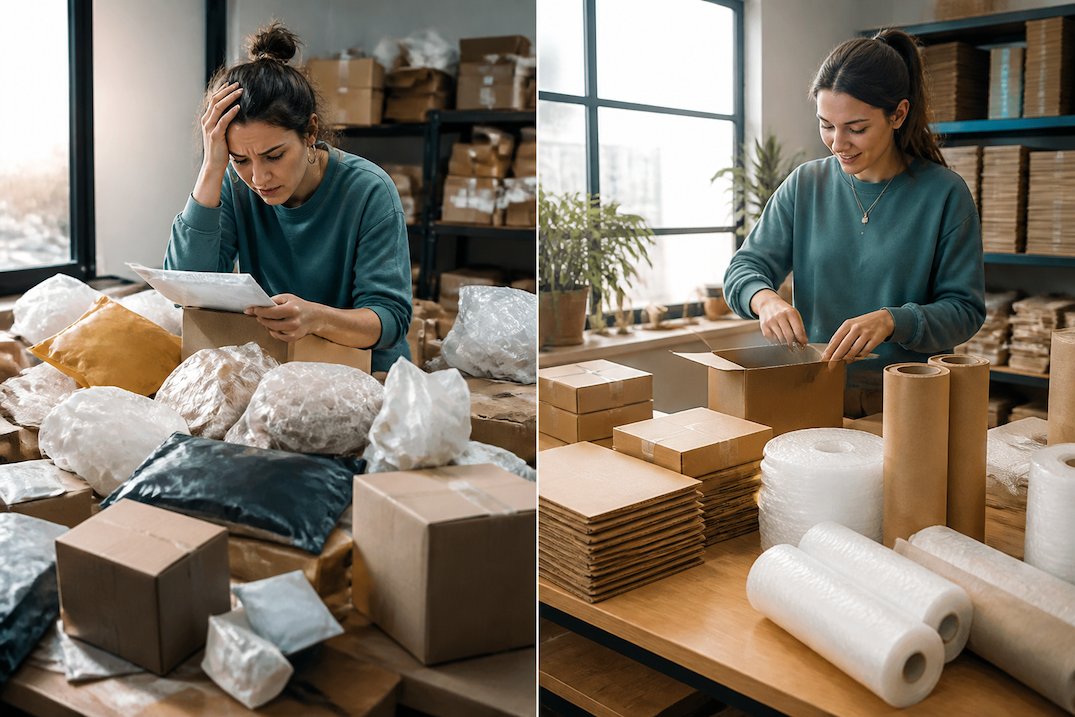
Twelve boxes left in the stockroom and forty orders sitting in the queue. That’s the moment most sellers panic-search “shipping supplies near me” and hope a local shelf has what they need. It usually doesn’t — not in the right size, not at a price that won’t wreck the margin on a $15 sale.
Warehouse managers stopped relying on that search years ago. They know a scramble for nearby boxes is a symptom, not a strategy. The sellers who never run out aren’t lucky. They’ve built a system: par levels, case-quantity reorders, a supplier that ships same-day instead of a store that might have your size on a good week. Free supplies from USPS or UPS have a place, sure — but they come with rules that don’t fit every product. What actually separates the sellers who scale from the ones stuck making emergency runs is how they think about sourcing packaging in the first place.
Why “Shipping Supplies Near Me” Isn’t the Real Answer for Growing Sellers
Picture a seller in a spare bedroom, Sunday night, 40 orders due Monday morning — and only 12 boxes left. They type shipping supplies near me into their phone, hoping a big-box store nearby has what they need. What they find instead: three sizes, none quite right, and a per-box price that makes their margin cringe.
The Local Store Trap: Limited Sizes, High Per-Unit Cost
Local shelves carry maybe 10-15 sizes total. A hardware store or office supply chain isn’t stocking for e-commerce — it’s stocking for movers. You’ll pay retail markup, sometimes double what bulk pricing gets you online, and you still won’t find the cube box or flat mailer your product actually needs.
Why Free Carrier Supplies Come With Hidden Strings
USPS and other carriers offer free boxes and envelopes, but those are restricted to specific mail classes and pre-set sizes. Use the wrong box for the wrong service, and you’ll get flagged or re-rated at pickup. Free isn’t free if it forces you into slower, pricier shipping tiers.
The Real Search Should Be “Reliable,” Not “Nearby”
What actually matters is consistent stock, fast delivery, and the right dimensions every time. Warehouse managers know that quality Mailing products delivered on schedule beat a five-minute drive to a store that might not have what’s needed anyway.
USPS, UPS, and FedEx Free Shipping Supplies: What You Actually Get
Free is free — until you’re the one paying for it in wasted time. Carrier boxes and mailers work fine for occasional sellers — they come with strings attached: branded exteriors, fixed sizes, and account requirements that don’t fit every business.
USPS Ground Advantage Boxes, Mailers, and Envelopes Explained
USPS offers no-cost boxes and envelopes for Priority and Ground Advantage service, but they’re only usable with that specific postage — not a general supply source. You can’t use a USPS box for UPS ground or freight. That’s the catch nobody mentions upfront.
UPS and FedEx Supply Programs: Boxes vs. Branded Packaging
UPS and FedEx run similar programs, but their branded boxes broadcast which carrier you’re using — not great if you’re building your own brand identity. For sellers wanting something more neutral, custom mailers make a bigger impression than a logo-covered box ever will.
Where Free Supplies Fall Short for Product-Based Sellers
Free programs don’t offer bulk quantities, custom sizing, or cushioning for fragile goods. Sellers moving real volume need actual sourcing: eco friendly shipping supplies for sustainability-minded buyers — Strapping and tools for anyone bundling multiple boxes onto pallets. Free supplies get you started. They won’t scale you.
Building a Dependable Supply System Instead of a Shopping Trip
How many times has someone on your team searched “shipping supplies near me” at 4:45pm because a size ran out? That’s not a system — that’s a fire drill. A real supply system means you know what’s coming, when it’s coming, and how much it costs before you need it. Warehouse managers who’ve been burned by stockouts stop treating packaging supplies as an errand and start treating them as inventory to be planned, tracked, and reordered on a schedule.
Setting Par Levels So You Never Run Out Mid-Fulfillment
Par levels work the same way for boxes as they do for raw materials. Pick a trigger point — say, a two-week buffer based on your average order volume — reorder the moment you hit it. Don’t wait until the shelf’s empty. Track usage by size, not just total volume; your 9×12 mailers might move three times faster than your 12x12x12 boxes.
Case Quantities vs. Pallets: Finding Your Right Order Size
Not every operation needs a pallet. If you’re shipping under 500 orders a month, cases keep cash flow healthy and storage manageable. Once you cross into higher volume, pallets bring the per-unit savings down significantly. And don’t overlook Packaging protection like bubble and void fill — order it on the same cycle as your boxes, not as an afterthought.
Cost Per Unit: The Number That Actually Matters at Scale
Here’s a number that surprises most new warehouse hires: a five-cent difference on a mailer, multiplied across 10,000 monthly shipments, adds up to $6,000 a year — real money, not rounding error. Managers who’ve run fulfillment for a while stop looking at sticker price and start looking at cost per unit across every order type. That’s the only number that tells you whether your packaging line is bleeding margin or protecting it.
Comparing Retail, Wholesale, and Bulk Packaging Pricing
Retail shelves (think office supply chains or hardware stores) charge the most because you’re buying convenience, not volume. Wholesale pricing kicks in once you commit to cases instead of single units, and bulk or pallet pricing drops the unit cost further still. The trick for growing sellers is finding a supplier who offers wholesale tiers without demanding pallet-sized commitments before you’re ready.
How Box and Mailer Size Affects Dimensional Weight Charges
Carriers bill by dimensional weight, not just actual weight — an oversized box for a light item can cost double what it should. Choosing the right footprint matters more than most sellers realize when shipping products that don’t need rigid protection. Switching from a box to a properly sized mailer often trims both material cost and carrier fees in one move.
What to Look for in a Packaging Supplier Built for Volume
Here’s a myth worth killing: the closest packaging supplies store isn’t always your best bet. Warehouse managers who’ve been burned by local runs know that proximity means nothing if the shelf is empty when you need 500 boxes by Friday. What actually matters is depth of stock, order cutoff times, and how many warehouses stand between the supplier and your dock door.
Inventory Depth, Same-Day Shipping, and Multiple Warehouses
A real volume supplier keeps thousands of SKUs on hand — not a curated 40-item catalog. Look for same-day shipping cutoffs (before 4 pm is standard), multiple regional warehouses to shrink transit time, and a track record of not substituting sizes mid-order. If you’re comparing options, this packaging store guide breaks down the questions to ask before you commit to a vendor.
Matching Box Strength and Mailer Type to Your Product Mix
Don’t default to one box style for everything you ship. A few rules that actually hold up:
- 32 ECT standard boxes handle general merchandise up to roughly 65 lbs.
- Double- or triple-wall boxes for dense or heavy freight.
- Poly mailers for soft goods — lighter weight, lower postage.
- Bubble mailers for anything fragile but not box-worthy.
Frequently Asked Questions
Where’s the best place to get shipping supplies?
Depends on what you’re shipping and how often. If you need a box today, sure, check your local post office or a packaging supplies store near you. But if you’re running an Etsy or Amazon shop and reordering every week, buying online in bulk from a dedicated packaging supplier beats driving around town every single time. Search “shipping supplies near me” for emergencies — build a real supply chain for everything else.
Where can I get shipping supplies for free?
USPS gives away Priority Mail and Ground Advantage boxes, envelopes, and shipping bags at no cost — you’re paying for the postage, not the box. You can grab them at the counter or order them shipped to your door. Just know they’re branded Priority Mail material, so they’re not exactly built for custom or branded unboxing.
Are USPS free shipping supplies really free?
Yes, genuinely free — no catch, as long as you’re using them for Priority Mail or Ground Advantage shipments. The catch most sellers miss: you can’t use a free Priority box — then ship it Ground Advantage-rate or First Class. Mixing that up is one of the most common mistakes new sellers make, and it can get your package held up.
Can I buy shipping supplies at USPS?
Not really — post offices hand out their own branded boxes and envelopes for free, but they don’t sell tape, bubble mailers, poly bags, or void fill. For that stuff, you’re looking at a packaging supplier, Home Depot, Office Depot, or an online shop. Same goes for FedEx and UPS locations — they’ll sell you supplies over the counter, but the pricing there is retail, not wholesale.
What’s the real cost difference between free USPS boxes and buying my own?
Free is free — but it locks you into USPS shipping and their exact box dimensions, which don’t always fit your product. Buying your own corrugated boxes or poly mailers in bulk usually costs a few cents to under a dollar per unit depending on size, and you get total control over sizing, branding, and carrier choice. For sellers shipping 50+ orders a month, bulk-bought supplies almost always win on total cost per shipment.
Do UPS and FedEx offer free shipping supplies as USPS does?
Sort of. UPS offers some free supplies through their online ordering portal if you’re an account holder, but selection is limited compared to USPS. FedEx does something similar for account customers. Neither comes close to matching USPS’s free box and envelope program in scope.
What size box should I use to avoid extra shipping fees?
This is where most new sellers lose money without realizing it. Carriers charge dimensional weight — length times width times height divided by a set number — so an oversized box for a lightweight item gets billed like it’s heavier than it is. Stock a real range of sizes (cube, flat, tall, whatever fits your product line) instead of defaulting to one “good enough” box.
What’s better for clothing and soft goods — a poly mailer or a box?
Poly mailers, hands down, for anything that isn’t fragile. They weigh next to nothing, which keeps postage low; they’re weatherproof, and they store flat so they don’t eat up your shelf space. Save boxes for anything with hard edges or breakable parts.
Is it cheaper to buy shipping supplies wholesale instead of one box at a time?
Almost always, yes. Buying a sleeve of 25 boxes from a big-box retail store costs a lot more per unit than ordering a case of 100 from a wholesale packaging supplier. If you’re shipping regularly, even a modest order size gets you meaningfully better pricing than retail shelf prices.
How fast can I get packing and shipping supplies if I’m about to run out?
That’s the real question small sellers should be asking instead of just searching for the nearest store. A lot of online packaging suppliers offer same-day shipping if you order before a set cutoff time, with multiple warehouses around the country keeping transit times short. That beats driving to three different stores hoping one has the size you need in stock.
Here’s what separates sellers who scale from those who stall out: they stop treating packaging as an emergency purchase and start treating it as a supply chain. Typing “shipping supplies near me” into a search bar might solve today’s problem, but it won’t solve next month’s. Par levels, case-quantity ordering, and a real handle on cost per unit will.
Free carrier boxes have their place — but they’re not a strategy; they’re a stopgap. And dimensional weight doesn’t care whether your mailer was free or not. It only cares about size.
So what should a growing seller actually do? Find a supplier with deep inventory across sizes, same-day dispatch, and warehouses spread out enough to get boxes to the door fast. Match box strength and mailer type to what’s actually being shipped, not what happened to be on hand. That’s how warehouse managers avoid 2 a.m. stockout panic.
The next step is simple: pull your last three months of order data, figure out your top five package sizes, and place a bulk order before you’re down to your last case. Stop shopping. Start stocking.

Recent Comments