
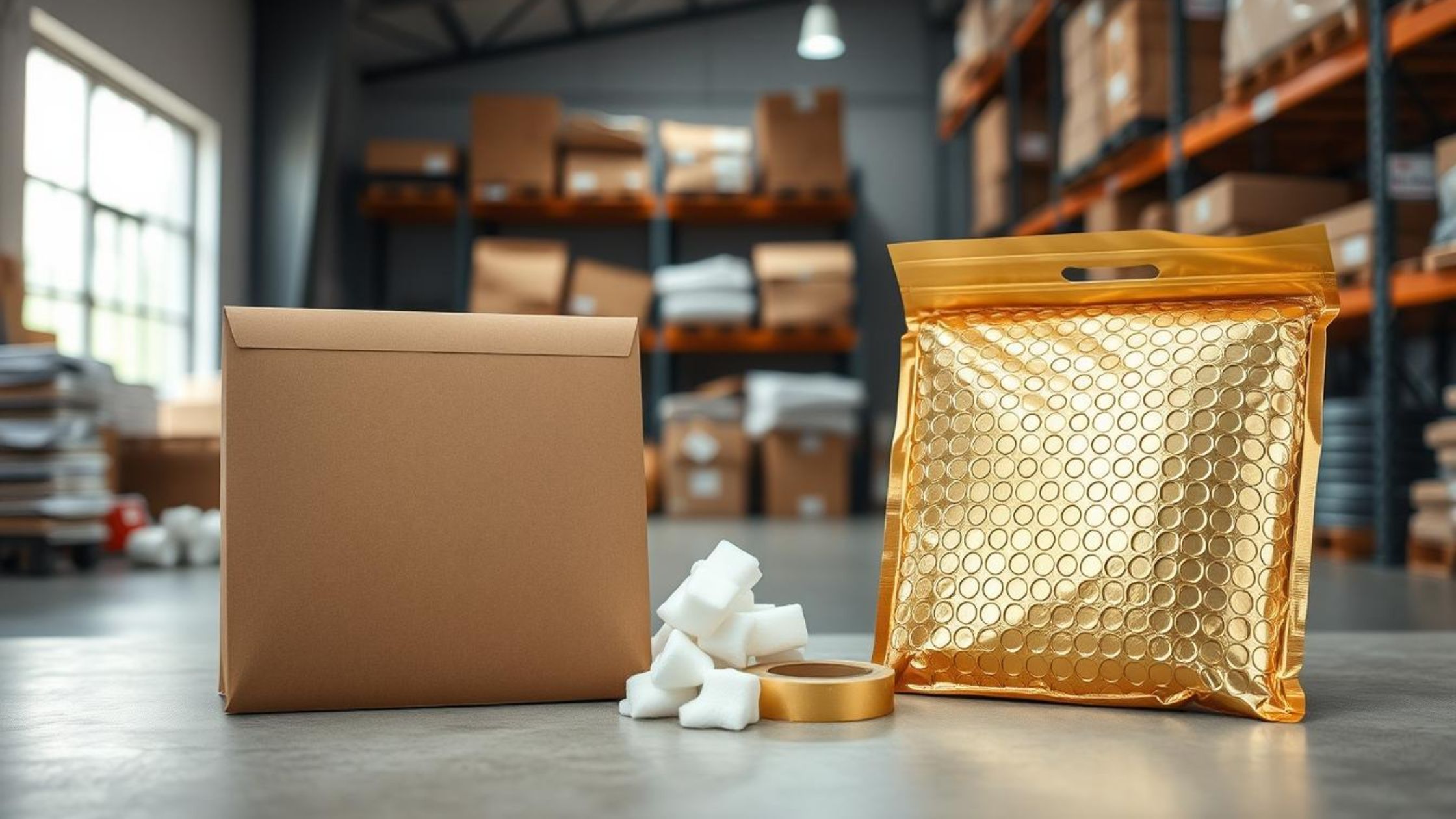
You’re standing at your packing station — maybe it’s a kitchen table, maybe it’s a corner of the garage — holding something you just made. Could be a hand-poured candle. Could be a delicate pair of earrings or a print you spent hours getting right. And the question hits you the same way it always does: which envelope is actually going to get this thing there in one piece?
That little moment of hesitation? I know it well. I’ve been there more times than I can count. This guide is built around that exact feeling — the need to make a smart call that protects your work, keeps your costs reasonable, and still looks decent when your customer tears it open. We’re going head-to-head with two of the most popular protective envelope options out there, and by the end, you’ll know which one belongs in your workflow.
We’ll dig into how rigid corrugated construction stands up against impact-absorbing bubble cushioning. These aren’t just packaging details — they’re the difference between a five-star review and a refund request. Trusted suppliers like The Boxery stock both options in a range of sizes, so once you know what you need, sourcing it is the easy part.
Key Takeaways
- Your decision comes down to rigid structure versus flexible cushioning — and the fragility of your product tells you which way to lean.
- The nature of your item — flat and bend-prone or delicate and oddly shaped — is the single biggest factor in selecting a protective envelope.
- Shipping costs and per-unit pricing shift dramatically depending on whether you choose a heavier rigid sleeve or a lightweight padded option.
- A reliable peel-and-seal closure strip saves packing time and keeps the contents secure without extra tape.
- The way your package looks and feels when it arrives directly shapes how customers perceive your brand.
- Lightweight padded options work beautifully for protecting flat items like photographs, certificates, and important documents.
- Working with a dependable packaging supplier — one that actually keeps stock and ships fast — takes a surprising amount of stress out of your fulfillment process.
Introduction: The Packaging Crossroads
Somewhere between finishing a product and getting it out the door, every seller runs into the same fork in the road. Two styles of protective envelopes. Two very different approaches to keeping your stuff safe. And the direction you pick matters way more than you’d think — it shapes the customer experience, the condition of what arrives, and honestly, your own sanity.
I get the hesitation. I really do. You’re holding something you put time and care into, and you’re about to hand it over to a shipping carrier that doesn’t know or care what’s inside. It’s got to survive conveyor belts, sorting machines, maybe a toss onto a porch in the rain. Your envelope has one job: be the shield.
This isn’t just about stuffing something into a sleeve and slapping a label on it. You’re choosing a protector that needs to match what’s inside. A flat document needs rigidity — something that refuses to bend. A fragile trinket needs cushioning that absorbs a drop. Getting this right builds trust with the people buying from you. Getting it wrong… well, I’ve been there. Damaged goods, awkward apology emails, refunds that sting.
And the wrong call doesn’t just cost you a customer’s goodwill. It costs actual money. Replacement products, return shipping labels, wasted materials. A well-chosen cardboard mailers setup with the right seal can prevent all of that before it starts.
Think about the last package you received. The weight of the envelope in your hands. How easy it was to open. Whether the thing inside was pristine or rattling around in a too-big sleeve. That’s the exact experience your buyers have every single time. Those details add up — they become your reputation.
So that’s what we’re doing here. Walking through the specifics, from the stiff backbone of a corrugated kraft paper option to the featherweight cushioning of a bubble-lined envelope. No jargon overload, no fluff. Just the stuff you need to know to pick the right protector.
We should also talk about the practical side, because it matters just as much. Weight affects postage. Postage affects your per-unit cost. And features like a self-adhesive peel strip? They’re small details that save real time when you’re packing dozens of orders on a Tuesday night.
Companies like The Boxery have been doing this for over 25 years, and they understand the balancing act between protection, price, and presentation. Having a reliable supplier in your corner — one that doesn’t run out of stock the week you need to reorder — makes the whole operation smoother. Whether you’re shipping documents, prints, jewelry, or handmade goods, the right envelope is out there.
Let’s move past the uncertainty and into clarity. By the time you’ve read through what each option actually does, you’ll be able to make a confident pick. One that reflects the care you’ve already put into your product.
The Sturdy Defender: An In-Depth Look at Cardboard Mailers
When your product absolutely, positively needs to arrive looking exactly the way it left your hands, a rigid corrugated sleeve is the one you reach for. This isn’t passive protection — it’s active. It’s engineering. Think of it less like packaging and more like a bodyguard that happens to be flat.
The strength here comes from layers. Solid rigid board, fluted corrugated material sandwiched together — it creates a shell that won’t buckle. Won’t fold. Won’t cave in when a heavy parcel gets stacked on top of it at the sorting facility.
You feel it the second you pick one up. There’s a heft to it. A seriousness. Your hands know immediately that this thing means business. And your customer feels that same confidence before they even break the seal.
Superior Structure and Rigid Protection
Here’s where the magic lives. Quality rigid board options — like what The Boxery stocks — use 300 to 350 GSM kraft paper. GSM stands for grams per square meter. It’s a density measurement, and at that range, you’re looking at something genuinely stiff.
This isn’t thin cardstock that bends if you look at it wrong. It’s a fortress. Documents arrive uncreased. Prints stay flat. Small items keep their shape through every rough mile of transit.
Corrugated versions take it up another notch. Those air-filled flutes between the paper layers act like built-in shock absorbers — except they don’t compress and stay compressed. They maintain the rigid form while still buffering against impact. It’s a dual-action defense, and it’s the reason sellers who ship vinyl records, certificates, or hardcover books swear by them.
I learned this the hard way, honestly. Shipped a set of hand-lettered prints in a flimsy envelope once because I was trying to save a few cents. They arrived with a crease right down the middle. Customer was gracious about it — sent a photo, asked for a replacement. But I felt sick. That crease wasn’t just damage; it was hours of my work, ruined by a bad packaging call. Never again.
Ideal Use Cases and Common Applications
So when does the rigid option become your go-to? Basically, any time the item inside needs to stay perfectly flat or can’t tolerate bending. That covers a surprising range of products.
- Business Essentials: Contracts, glossy catalogs, magazines, legal documents, and anything that needs to look untouched when it arrives.
- Media and Memorabilia: CDs, vinyl records, signed photographs, certificates, diplomas — items where even a minor bend is unacceptable.
- E-commerce Staples: Books, small electronics with flat profiles, artisan jewelry on cards, handmade candles in fitted inserts.
- Special Occasions: Luxurious wedding invitations, event programs, or holiday cards where the presentation is the product.
The Boxery’s lineup really shines in this space. Their Manila Brown Peel & Seal Rigid Board mailers come in five precise sizes — from a compact 120x120mm square all the way to a larger C4 format. The white corrugated options are crush-resistant, solid enough for shipping clothing, food items, or anything that needs to arrive looking professional and undamaged.
What I appreciate is the versatility. One sturdy envelope type can serve a dozen different purposes, depending on the size you grab. That simplifies inventory, which matters a lot when your “warehouse” is a closet.
Cost-Effectiveness and Professional Presentation
Let’s get into the money side, because that’s where decisions get real. The upfront cost per unit on a rigid kraft envelope is typically a bit higher than a bubble-lined alternative. That’s just the nature of the material.
But here’s the thing — the protection is baked in. You usually don’t need to add extra bubble wrap inside. You skip the outer box. That cuts your total packaging cost, sometimes significantly. And when you pick the right size from the jump, you’re optimizing materials and potentially reducing your shipping costs because there’s less dimensional waste.
Then there’s the perception factor. A crisp, clean cardboard sleeve with a smooth finish and a secure peel-and-seal strip? It looks good. It looks intentional. It looks like a business that cares about what it sends out. And that impression — before the customer even sees the product — sets the tone for the entire experience.
I remember when I switched from reusing old Amazon boxes to proper rigid envelopes for my prints. The difference in customer feedback was immediate. People mentioned the packaging. They said it felt “premium.” One person told me it felt like receiving a gift. That kind of response doesn’t show up on a spreadsheet, but it absolutely drives repeat orders.
The Boxery makes this accessible for small sellers, too. With per-unit pricing that ranges from roughly $0.28 to $1.59, depending on size, and options for cost-effective bundles, you don’t need to be a massive operation to look like one. It’s an investment in your product’s journey and your brand’s staying power.
The Flexible Cushion: Understanding Bubble Mailers
Now let’s flip the script. Some items don’t fear a crush — they fear a drop. A sudden jolt. The kind of force that happens when a package slides off a conveyor or gets tossed into a delivery truck. For those products, the defense strategy shifts entirely. You’re not looking for rigid armor. You’re looking for something that absorbs, that wraps, that gives just enough to keep your item safe.
That’s bubble-lined territory. And if you’ve ever wondered how many different types of mailers exist and which ones actually make sense for your products, the bubble-lined envelope is one of the most versatile answers out there.
Think of it as active shock absorption. Unlike a stiff paper sleeve that resists force, this one absorbs it. Every air-filled cell in that lining is doing work — dissipating energy before it ever reaches your product.
Impact Absorption and Lightweight Security
Each tiny bubble isn’t decorative. It’s functional. When something hits the outside of the envelope, those air pockets compress and spread the force across a wider area. The energy gets absorbed instead of transferred straight to your item. Physics, working in your favor for once.
And the weight — this is where bubble-lined options really earn their keep. They’re astonishingly light. You’re adding meaningful protection without adding meaningful ounces to your shipment. That directly translates to lower postage, especially if you’re shipping frequently.
For high-volume sellers, that weight difference is money. Real money. I did the math once after switching some of my lighter jewelry shipments from small boxes to padded envelopes. Saved about 30 cents per shipment on postage. Doesn’t sound like much until you multiply it across a few hundred orders in a month. Suddenly, that’s rent money.
Best for Fragile and Odd-Shaped Items
Here’s the superpower: flexibility. A rigid cardboard sleeve has a fixed shape. It doesn’t negotiate. A bubble-lined envelope? It conforms. It wraps itself around whatever you slide inside.
A small ceramic figurine. A piece of jewelry with sharp findings that could snag on flat packaging. A stack of photographs that needs cushioning on all sides. Even oddly shaped items that don’t fit neatly into a rectangle — the padded lining adjusts, fills gaps, and prevents movement during transit.
That adaptability is huge for artisan sellers and crafters who ship a range of different products. Not everything you make is the same shape or size. Having an envelope that rolls with the punches — literally — means fewer worries about whether the item is going to shift and bang around inside.
I keep a stash of poly bubble envelopes in three sizes on my packing shelf at all times. They cover probably 80% of what I ship. The other 20% goes in rigid sleeves or small boxes. But that 80% coverage from one envelope type? That’s efficiency I genuinely appreciate.
Weather Resistance and Shipping Weight
The shipping journey isn’t just about drops and stacks. There’s weather. Rain. Snow. Humid mailboxes that turn paper envelopes into soggy messes. A lot of bubble-lined options use poly exterior material — plastic, essentially — which gives them a solid degree of water resistance.
That poly construction also handles tears and punctures better than paper alone. It adds a layer of toughness that holds up when the envelope gets dragged across rough surfaces or squeezed through a tight mail slot.
When you combine the water resistance, the tear strength, and the lightweight advantage, the value equation gets really clear. For items that are small, delicate, and not crazy heavy, a padded poly envelope hits a sweet spot that’s hard to beat on cost and protection combined.
The Boxery stocks quality bubble-lined options with reliable peel-and-seal closures — no tape gun required. They’re part of a complete protective envelope lineup that gives sellers a full toolkit. Whether you’re wrapping fragile goods or just need something more protective than a plain paper sleeve, they’ve got you covered.
Choosing Your Champion: A Decision-Making Guide
Alright, we’ve laid out the contenders. Now it’s time to make the actual call. This is where theory turns into a packing decision you can feel good about — one that lines up with what you’re shipping and what you can afford.
We’ll turn your product’s specific needs into a straightforward plan. Match the protector to the item, then line up the economics. Simple as that.
Match the Mailer to Your Product
Start with one question, and be honest about the answer: What is the biggest threat to my item during transit? Is it bending and crushing? Or is it impact and shock? Your answer points you directly to the right envelope.
When you’re comparing shipping mailers, this table makes the decision visual. Use it as a quick-reference guide when you’re standing at your packing station trying to decide.
| Your Product’s Primary Risk | Recommended Protector | Key Features & Benefits | Ideal Examples |
| Bending, Crushing, Must Stay Flat | Rigid Board / Corrugated Envelope | Unbending structure, professional finish, superior crush resistance. Often made from sturdy kraft paper. | Important documents, certificates, magazines, hardcover books, art prints, vinyl records. |
| Impact, Shock, Fragile & Odd Shapes | Bubble-Lined Mailer | Flexible cushioning, lightweight, conforms to item shape, often with a water-resistant poly exterior. | Jewelry, small electronics, ceramic items, delicate photos, figurines, and irregular handmade products. |
| Mixed Items (e.g., book + fragile insert) | Assess Primary Risk | Choose based on the most vulnerable component. Consider adding a layer of internal cushioning inside a rigid envelope. | A book with a glass bookmark: Use a rigid envelope with internal bubble wrap for the fragile piece. |
Pick up your product. Feel the weight. Note the shape, the edges, the weak points. Let that physical check guide you. And if you’re shipping multiple different products, you’ll probably end up needing both types — which is fine. The Boxery offers both rigid and cushioned envelopes in a range of sizes, so stocking up on the exact dimensions you need is straightforward.
Balancing Protection with Budget
Now — the money conversation. Because protection means nothing if you can’t afford to offer it consistently.
The true cost of shipping isn’t just the price tag on the envelope. It includes the risk of what happens when protection fails. A damaged product means a refund, a replacement shipment, possibly a negative review, and almost certainly a lost customer. That adds up fast. Way faster than the few extra cents a sturdier envelope would have cost.
When is that sturdier option worth the investment? When you’re shipping high-value documents, when the product is your brand’s first impression, or when the item is irreplaceable. That rigid structure and clean presentation communicate something to the buyer — that you take this seriously. That matters.
On the flip side, a well-made bubble-lined envelope is a genuinely excellent protector for lightweight, fragile items at a lower per-unit price. The reduced weight keeps postage costs down, which is a significant advantage when you’re shipping high volumes. It’s not a compromise — it’s the right tool for the right job.
Think of your packaging as insurance. Cheap insurance that doesn’t pay out when you need it is worse than no insurance at all. Good insurance — the kind that’s proportional to the risk — saves you from the costs you’d rather never deal with.
Buying in bulk stretches the budget further. The Boxery offers cost-effective bundles on both rigid and padded envelopes, bringing the per-unit price down to a point where quality protective packaging is accessible even for small operations. Look for features like the peel-and-seal closure — it saves time, secures the contents, and eliminates the need for a tape gun. Smart details that add up across hundreds of shipments.
Conclusion
You’ve got the knowledge now. Choosing between a rigid corrugated envelope and a bubble-lined option doesn’t have to feel like a gamble anymore. It comes down to a single, clarifying rule: match the protector to your item’s greatest risk.
If your product needs to stay flat — documents, prints, certificates, books — a stiff kraft envelope delivers the unbending structure that laughs at crushing forces. If your product is delicate, irregularly shaped, or just needs something that absorbs a rough ride, the cushioning inside a bubble-lined envelope is built for exactly that. And either way, a solid peel-and-seal strip means secure closure without fumbling for tape.
Here’s the thing I’ve come to appreciate after years of shipping my own handmade products: your packaging talks. Before anyone sees what’s inside, they’ve already formed an opinion based on what’s outside. The weight of the envelope, the material, and the condition it arrives in. It’s a silent ambassador — and it either says “this person cares” or it doesn’t.
We’d recommend exploring The Boxery‘s curated selection of protective envelopes. With over 25 years in the packaging game and a lineup that covers both rigid and cushioned options across a range of sizes, they make it straightforward to balance protection, presentation, and price. Choose the envelope that delivers both your item and your brand’s promise — intact.
FAQ
Which type of mailer offers better protection for my items?
It depends entirely on the nature of what you’re shipping. For flat, rigid items like important documents, photographs, or sturdy products that need to stay uncreased, a cardboard envelope provides superior crush resistance — it simply refuses to bend. For delicate, oddly shaped, or fragile goods, a bubble-lined envelope’s cushioning is the clear winner when it comes to absorbing impact and shock during transit. The “better” option is whichever one addresses your product’s specific vulnerability.
Are cardboard shipping envelopes more expensive than bubble mailers?
Generally, yes. The materials and manufacturing process behind rigid kraft envelopes result in a slightly higher per-unit price point. However, their built-in protection often eliminates the need for additional cushioning materials inside, and their professional appearance can justify the investment — particularly for high-value or presentation-sensitive shipments. Bubble-lined options tend to be more budget-friendly, especially for lightweight goods where postage savings from the lower weight add up significantly over time.
How do I seal a cardboard mailer securely?
Most modern rigid envelopes come with a convenient peel-and-seal adhesive strip built right in. You peel back the protective liner, press the flap down firmly, and you’ve got a strong, tamper-evident closure. No tape required. It’s faster and more secure than a standard envelope closure, and it holds up reliably through the shipping process. If you’re packing multiple orders in a sitting, that saved time per package adds up quickly.
Can I use a bubble mailer for books or important papers?
You can, but it’s not the ideal choice. Books and documents need rigidity to prevent bending and creasing — and a bubble-lined mailer‘s flexible walls won’t provide that structural resistance. Under pressure from heavier packages stacked on top, those items can still bend or fold. For keeping papers, prints, and books perfectly flat during transit, a sturdy cardboard envelope is the professional and more protective choice.
Which packaging option holds up better in wet weather?
Standard cardboard and kraft paper envelopes offer minimal water resistance on their own. If your shipment might encounter rain, snow, or damp conditions during delivery, look for rigid envelopes with a weather-resistant coating or finish. Many bubble-lined options feature a poly (plastic) outer layer that provides solid protection against moisture, making them a stronger choice for weather-prone shipping routes. If moisture is a real concern for your products, the poly bubble envelope has a clear advantage in this category.

Recent Comments