
Key Takeaways
- Cut postage by shifting the right SKUs into poly bubble mailers, especially apparel, accessories, beauty items, and other orders under 2 pounds that don’t need a corrugated box.
- Compare poly bubble mailers against plain poly mailers before buying in bulk: the bubble lining adds protection for small electronics, collectibles, and health items, while still keeping pack weight low.
- Match sizes like 10×13 and other common mailer formats to actual product dimensions, since oversized mailers raise pack-out waste, slow pick-pack speed, and can push postage higher.
- Check USPS acceptance rules, label placement, package thickness, and mail class before rollout—small setup mistakes with poly bubble mailers can create rate changes, scan issues, or rejected mail.
- Test poly bubble mailers with real orders first by tracking damage rate, return rate, and pack cost per shipment; cheap case pricing means nothing if the wrong spec creates replacements and reships later.
For lightweight orders, the box is losing the argument. Once a shipment drops under 2 pounds, poly bubble mailers often beat boxes on cost, pack speed, and storage all at once—and for busy fulfillment teams, that changes margin math fast. A one-ounce difference doesn’t sound like much until it’s repeated across 500 orders a day.
In practice, that’s why more DTC teams are reworking pack stations around mailers instead of corrugated. A bubble-lined mailer can protect a folded tee, beauty item, paperback, or small accessory without the extra cube of a box or the added void fill that pushes rates higher. But the honest answer isn’t that mailers are always better. It’s that they work better for a narrow, high-volume slice of shipments—the kind that quietly drains profit if packaging choices stay stuck in last year’s habits.
Poly bubble mailers are winning on cost, speed, and storage for lightweight shipments
Boxes are losing ground.
Shipping teams feel it every week: postage keeps climbing, pick faces stay crowded, and dead air inside a box still gets billed. The answer, for items under 2 pounds, is often poly bubble mailers.
How poly bubble mailers cut postage on first-class, priority, and flat-rate shipments
A lightweight bubble mailer trims both package weight and cubic size, which helps on USPS mail, first-class package service, priority shipments, and some flat-rate decisions where a box would be overkill. In practice, a 10×13 poly mailer can shave ounces off the total shipment, and those ounces matter when postage rates jump at the 4, 8, and 16 ounce marks.
For soft or semi-fragile orders, teams usually compare:
Simple idea. Harder to get right than it sounds.
- Boxes: better for crush risk, worse for postage and storage
- Poly bubble mailers: lower weight, fast packout, easy label placement
- Paper mailers and a kraft bubble mailer: useful where recyclable presentation matters more than moisture resistance
Why mailers take less warehouse space than boxes, envelopes, and padded bags
Space matters. A case of mailers stores flat, while boxes, envelopes, and padded bags eat shelf depth fast. That difference shows up in labor too—fewer carton builds, less tape, and quicker pack stations during peak mail volume.
And a branded presentation doesn’t have to mean a box. A run of colored bubble mailers can sort product lines by size or class without slowing the line.
Where 10×13 and other common sizes fit apparel, accessories, books, and small electronics
Common sizes work best when the SKU profile is tight:
- 10×13: folded apparel, flat accessories, thin books
- Small sizes: postcards, cables, cosmetics, phone cases
- Extra room formats: scarves, bundles, and expandable kraft mailers
The honest answer: for under-2-pound orders that don’t need rigid walls, poly bubble mailers usually beat boxes on cost, speed, and bulk storage.
What poly bubble mailers actually are—and how they differ from poly mailers and padded envelopes
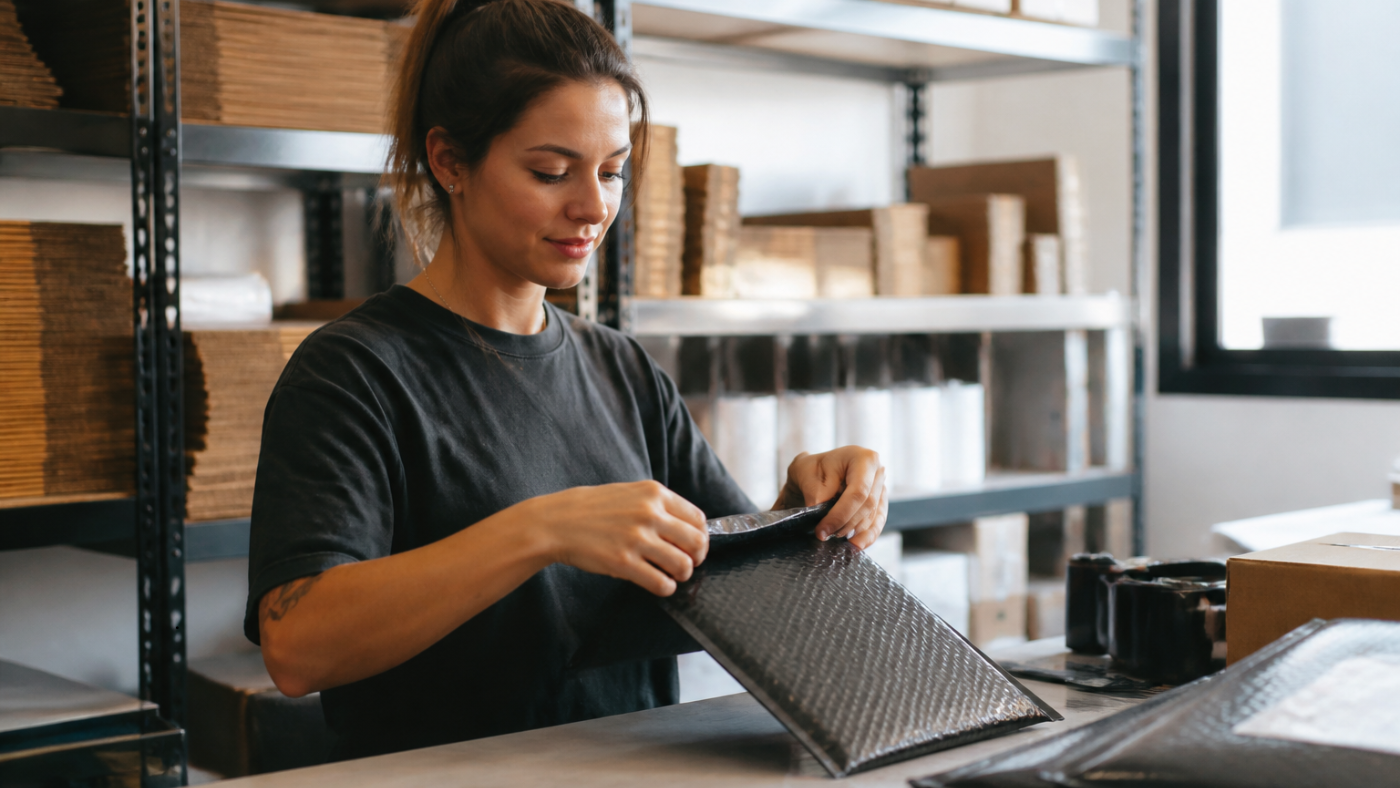
What are buyers really getting with poly bubble mailers—and are they just a fancier envelope? Not quite. They combine a slick poly outer shell, a cushioned bubble lining, and a peel-and-seal strip into one lightweight mailer made for items that need more than a flat bag but less than a box.
The outer poly layer, inner bubble lining, and self-seal closure are explained
The outer layer resists moisture, scuffs, and sorting-line dirt. Inside, air-filled bubbles add shock protection for small goods like phone cases, cosmetics, chargers, or a 10×13 apparel order with one fragile add-on. The self-seal closure speeds packing, keeps the label area flat, and cuts tape use—a small change, but across bulk orders it saves time.
A standard bubble mailer adds padding that plain poly mailers and basic paper mailers don’t provide.
Poly mailer vs bubble mailer: protection, weight, and best-use cases
Here’s the practical split:
- Poly mailer: best for soft, non-breakable goods like tees
- Bubble mailer: better for small items that can crack, scratch, or bend
- Kraft bubble mailer: fits brands that want a paper look
- Expandable kraft mailers: useful for thicker books, stacks of postcards, or flat bundles
- Colored bubble mailers: often used for brand presentation and sorting
When a bubble-lined mailer works better than a box for items under 2 pounds
For first class — other postage-sensitive shipments under 2 pounds, poly bubble mailers often beat boxes on weight and storage. They ship flat, take up less shelf space, and usually need less void fill. That’s why fulfillment teams use them for jewelry, supplements, small electronics, and other low-cube items where protection matters but extra size only raises mail rates.
The data backs this up, again and again.
When should operations teams choose poly bubble mailers instead of boxes?
Here’s the counterintuitive part: for items under 2 pounds, the package choice often changes postage more than the product weight does. In practice, poly bubble mailers beat boxes when the item is light, low-profile, and doesn’t need rigid wall protection—especially for first class or other mail service tiers where every inch affects rates.
Best products for poly bubble mailers: clothing, beauty, health items, collectibles, and small parts
A bubble mailer works well for soft goods, sealed beauty units, boxed health items, trading cards, and bagged small parts with smooth edges. Teams also use colored bubble mailers for order sorting and faster pick-pack flow (a simple visual cue that saves seconds per order). For brands shifting toward recyclable presentation, a kraft bubble mailer can replace some flat boxes without adding much pack time.
- Best fit: apparel, cosmetics, supplements, postcards, and 10×13 soft-pack orders
- Better than boxes: less cube, less void fill, easier label placement
Shipments that still need boxes: crush-risk products, sharp edges, and extra void space
Boxes still win for crush-risk goods, anything with corners that can puncture poly, and products that need extra bubble or paper mailers for bracing. If an item can shift, crack, or bend in transit, a box is the safer call—returns cost more than cheap postage ever saves.
A quick decision framework based on item weight, fragility, dimensions, and return rate
- Under 2 lb and non-fragile? Start with poly bubble mailers.
- Sharp, brittle, or high return rate? Use boxes.
- Needs expansion but not full corrugate? Test expandable kraft mailers.
Shipping rules and label setup matter more than most teams think
Mail acceptance failures usually start with bad prep, not bad postage.
- Match the package to the service. USPS accepts poly bubble mailers, but teams still need the right mail class, a clean label, and an accurate package size. A soft bubble mailer can ship as Ground Advantage or Priority Mail; it won’t move as a letter or flat once thickness, padding, and shape push it into parcel handling.
- Measure after packing. Final size drives rates. A 10×13 mailer that bulges past one inch can price very differently from the same mailer packed flat. Extra thickness, uneven edges, or a folded label can also trigger manual review.
- Place the label on the flattest face. Keep the shipping label and postage barcode clear of seams, closures, and dents. In practice, even a small wrinkle near the label can slow acceptance—or kick the parcel into adjustment.
USPS rules for poly bubble mailers, mail class choices, and postage planning
For items under 2 pounds, teams usually compare Ground Advantage with Priority options rather than stamps, First-Class letter pricing, or Flat Rate boxes. The honest answer is simple: weigh the sealed mailer, print the label after pack-out, and avoid guessing on postage.
How label placement, thickness, and final package size affect mail acceptance and rates
A Kraft bubble mailer or one of the expandable Kraft mailers can save space versus boxes, but only if the thickness stays controlled. Some brands also test colored bubble mailers, paper mailers, and custom print runs—yet label readability still matters more than looks.
Recyclable claims, custom print options, and what buyers should confirm before ordering in bulk
Before ordering bulk or wholesale quantities, buyers should confirm material specs, seal strength, and whether recyclable claims apply to curbside programs or store drop-off only (big difference). That check matters just as much for poly formats as it does for paper-based options.
Buying poly bubble mailers at scale without wasting money on the wrong size or spec
Think of this like a purchasing check, not a packaging debate. For teams buying poly bubble mailers in bulk, the lowest case price can backfire fast—especially if the wrong size forces extra void fill, higher postage, or slower pack-out.
How to compare bulk and wholesale pricing across sizes, case packs, and total landed cost
Start with the total landed cost per shipped order, not just the unit price on the mailer. A bubble mailer priced at $0.22 can beat a $0.19 option if it cuts postage, fits a 10×13 label cleanly, and lowers damaged mail returns.
- Case pack math: 250 vs. 500 vs. 1,000
- Outside dimensions: usable interior space matters more than the listed size
- Material: poly, kraft bubble mailer, or paper mailers
- Freight: folded into the true per-unit cost
In practice, colored bubble mailers can help sort orders by SKU family or service level (a small gain, but real).
What operations managers should test first: damage rate, pick-pack time, and pack-out cost per order
Test three sizes for 2 weeks—small, medium, and large mailers—across 100 to 300 orders each. Track damage rate, pack seconds per order, postage class, and total pack-out cost. That tells ops teams more than any sales sheet ever will.
The common purchasing mistakes that make cheap mailers expensive fast
Three mistakes show up again and again:
- Buying one size for everything
- Ignoring closure strength and puncture risk
- Choosing expandable kraft mailers for items that need more cushion than flex
And one more thing. If a mailer replaces small boxes on paper but drives even a 2% damage spike, it isn’t cheap anymore.
It’s a small distinction with a big impact.
Frequently Asked Questions
Does the USPS allow poly mailers?
Yes. USPS accepts poly bubble mailers and standard poly mailers as long as the package is sealed well, the shipping label is readable, and the contents fit the service level you choose. If the mailer is thick, rigid, or bulky, postage and class rules can change fast—so the package should be measured and weighed before buying stamps or printing postage.
Does Dollar Tree carry poly mailers?
Sometimes, but stock is hit or miss — size options are usually limited. For a business shipping every week, relying on a discount store for poly bubble mailers isn’t a great plan because you need consistent sizes, stronger adhesive, and a predictable cost per mailer.
Does the USPS give free bubble mailers?
USPS offers some free Priority Mail — flat rate envelope packaging, including padded mailers tied to that service. Those aren’t generic poly bubble mailers for any shipment, and they can’t be used with first-class or other postage unless the packaging matches USPS rules.
What is the difference between a poly mailer and a bubble mailer?
A poly mailer is a lightweight plastic envelope with no built-in cushioning, so it’s best for clothing, soft goods, and other non-breakable items. A poly bubble mailer adds interior bubble padding, which gives small products extra protection without the weight of boxes, kraft paper, or loose fill.
Most people skip this part. They shouldn’t.
When should a business use poly bubble mailers instead of boxes?
Use poly bubble mailers for small items that need light impact protection but don’t need a rigid carton—phone cases, cosmetics, accessories, small electronics, and some books are common examples. If the item is fragile, sharp-edged, or expensive enough that a crush risk matters, a box usually works better.
Are poly bubble mailers recyclable?
Some are, but not all, through curbside recycling. Most poly bubble mailers need store drop-off recycling if they’re made from plastic film, and paper-plastic mixed mailers can be harder to process, so the material specs matter more than the marketing on the label.
What size poly bubble mailer should be used?
The right size should fit the item closely without forcing the seal or leaving lots of empty space. Popular sizes like 10×13 work well for medium products, but a business should test a few sizes first, because even one extra inch can raise postage, waste materials, and slow packing lines.
Can poly bubble mailers be used for first-class mail?
They can be used for USPS Ground Advantage or other package services if the piece qualifies as a package, but they usually aren’t treated like a letter or postcard. Once a bubble mailer has thickness, padding, or a non-flat shape, it moves out of letter pricing and into package rates.
Are custom poly bubble mailers worth it for growing brands?
Sometimes. Custom poly bubble mailers can help with brand presentation and can make a shipment look more polished — operations teams should check the math first—unit price, minimum order, storage space, and reorder timing all matter more than looks if volume is still uneven.
Do poly bubble mailers save money on postage?
Often, yes. They’re lighter than boxes, take up less space, and can lower total shipping costs for small products, but only if the mailer size matches the item and the product doesn’t need extra packing materials. Bad fit kills the savings.
For operations teams shipping light orders every day, the shift away from cartons isn’t just about shaving a few cents off materials. It’s about lowering postage, moving pack-outs faster, and freeing up shelf space that boxed inventory used to eat up. That’s why poly bubble mailers keep showing up in more apparel, beauty, accessories, book, and small-parts workflows—especially where orders stay under 2 pounds and don’t need rigid wall protection.
Still, the smart move isn’t swapping everything at once. The better approach is tighter than that. Match the mailer to the item, confirm label fit and finished thickness, and watch where damage risk starts to climb. A mailer that looks cheap on paper gets expensive fast if it drives replacements, rework, or carrier issues.
The next step is straightforward: pull the top 10 SKUs currently shipping in small boxes, run a 30-day test with poly bubble mailers, and track three numbers only—pack-out time, postage per order, and damage rate. If the numbers hold, roll the change into the next purchasing cycle with confidence.

Recent Comments